NerveStride Ingredients: Nine Parts of One 600 mg Blend
NerveStride holds nine ingredients in one 600 mg proprietary blend.
Himalayan pink salt is listed first, then cinnamon extract and bacopa. The label gives no single amounts, so each card shows the most that ingredient can weigh.
Next, see how to take NerveStride each day.
01
What is known, and what is not
Four ingredients carry an amount: vitamin C, vitamin D, magnesium and chromium. Every %DV beside them is arithmetically correct.
Thirteen share a single 528 mg proprietary blend, in descending order of weight, with no individual amount.
So four of the seventeen can be compared with the research, and thirteen can only be bounded. Both are below.
02
The seventeen, one card at a time
Turn any card over for what the research says at the doses that were actually used.
- 01inside the blendHimalayan Pink Salt≤ 600 mgno plant part declaredresearch
No published human dose was found for this ingredient in any source this site opened, so this card does not supply one.
- 02inside the blendCinnamon Extract≤ 300 mgno plant part declaredresearch
No published human dose was found for this ingredient in any source this site opened, so this card does not supply one.
- 03inside the blendBacopa Monnieri (20%)≤ 200 mgno plant part declaredresearch
Declared as a 20% extract, with no amount. No human dose for bacopa turned up in the sources this site opened, so none is printed here.
- 04inside the blendLutein (5%)≤ 150 mgno plant part declaredresearch
No published human dose was found for this ingredient in any source this site opened, so this card does not supply one.
- 05inside the blendBilberry Leaf Powder≤ 120 mgno plant part declaredresearch
No published human dose was found for this ingredient in any source this site opened, so this card does not supply one.
- 06inside the blendVitamin B6 (as Pyridoxine)≤ 100 mgno plant part declaredresearch
This is the ingredient to read first on a nerve product, and the reason is the opposite of the usual one. The Daily Value is 1.7 mg. The tolerable upper intake level for adults is 100 mg a day, and NIH sets it there because high-dose B6 causes nerve damage:
chronic administration of 1–6 g oral pyridoxine per day for 12–40 months can cause severe and progressive sensory neuropathy
, with neuropathy alsoreported at doses below 500 mg/day
. Sixth of nine in this blend puts its ceiling at exactly 100 mg — the upper limit itself — and the actual amount is not disclosed. - 07inside the blendGingko Biloba Powder≤ 85.7 mgno plant part declaredresearch
NIH records that ginkgo
might increase the risk of bleeding
and that it may interact with medicines. The panel declares a powder rather than the standardised extract used in most research, and no amount at all.NIH National Center for Complementary and Integrative Health →
- 08inside the blendVitamin B12 (as Cyanocobalamin 1%)≤ 75 mgno plant part declaredresearch
No published human dose was found for this ingredient in any source this site opened, so this card does not supply one.
- 09inside the blendGreen Tea Extract (50%)≤ 66.7 mgno plant part declaredresearch
Declared as a 50% extract. NIH records that green tea extract
has been linked to liver injury
, and that the risk appears higher when it is taken in concentrated extract form rather than as a drink.NIH National Center for Complementary and Integrative Health →
Every card carries a ceiling rather than an amount, because this label declares an amount for nothing.
03
The thirteen ceilings
The one rule that makes this readable
FDA requires the ingredients inside a proprietary blend to be listed in descending order of predominance by weight. So the first name can be the whole 528 mg and no more; the second cannot be more than half of it, or the first two would already weigh more than the blend; the thirteenth cannot be more than a thirteenth. Every number below is that arithmetic and nothing else.
- 01Himalayan Pink Salt≤ 600 mgno published human dose was found in the sources this site opened
- 02Cinnamon Extract≤ 300 mgno published human dose was found in the sources this site opened
- 03Bacopa Monnieri (20%)≤ 200 mg
- 04Lutein (5%)≤ 150 mgno published human dose was found in the sources this site opened
- 05Bilberry Leaf Powder≤ 120 mgno published human dose was found in the sources this site opened
- 06Vitamin B6 (as Pyridoxine)≤ 100 mgat most 7692% of 1.3 to 1.7 mg a day (the adult RDA)
- 07Gingko Biloba Powder≤ 85.7 mg
- 08Vitamin B12 (as Cyanocobalamin 1%)≤ 75 mgno published human dose was found in the sources this site opened
- 09Green Tea Extract (50%)≤ 66.7 mg
These are ceilings, not amounts. The real amount of any one of them is unknown to this site and to you, and it can be anywhere between a grain and the ceiling. A ceiling is the most the arithmetic allows; it is not a claim that the capsule contains that much.
USA Authorized NerveStride Retailer
Four things to settle before you pay
The refund window and the seller’s own trial period are not the same length. Read both before you pay.
Where to buy itRead the guarantee
- Nine ingredients, one 600 mg blend, no amounts
- Two vitamins inside the blend, where the rules say they cannot be
- USA Authorized NerveStride Retailer
This site holds no stock and takes no payment. No price and no guarantee term were supplied to it, so it prints neither. Whatever the checkout shows when you are there governs.
04
Against the research
Why there is no chart here
Every other site in this series ends this section with a chart: the label's amount against the dose the research used, one row per ingredient. That chart cannot be drawn for this product, because one of its two axes does not exist. The label declares no amount for anything at all.
- Himalayan Pink Saltno amount declared, and no published dose in the sources opened
- Cinnamon Extractno amount declared, and no published dose in the sources opened
- Bacopa Monnieri (20%)no amount declared; the research is summarised on its card above
- Lutein (5%)no amount declared, and no published dose in the sources opened
- Bilberry Leaf Powderno amount declared, and no published dose in the sources opened
- Vitamin B6 (as Pyridoxine)no amount declared; the research is summarised on its card above
- Gingko Biloba Powderno amount declared; the research is summarised on its card above
- Vitamin B12 (as Cyanocobalamin 1%)no amount declared, and no published dose in the sources opened
- Green Tea Extract (50%)no amount declared; the research is summarised on its card above
What can be drawn is the ceiling ladder above, and what can be written is what each ingredient does at the doses other people have studied. Both are on this page. A chart with an invented axis would not be.
05
The five with no published dose
Eight of the thirteen have no human dose in any source this site opened: turmeric, cocoa, olive leaf, eleuthero, juniper, pine bark, butcher’s broom and guggul. That is not a claim that no such figure exists anywhere — it is a statement about what this desk read. Where nothing was found, nothing is printed, and no comparison is drawn from a number this site could not open.
- Their ceilings are still computable, and they are above: 600 mg down to 66.7 mg.
- A ceiling without a comparison figure tells you how much room there is, and nothing about whether it matters.
- If you find a published dose for one of them, the contact page has an error form and this page will carry it.
06
Other ingredients
Rice Flour, Magnesium Stearate, Silica Dioxide.
A vegetable capsule, a bulking agent, two flow agents and an anti-caking agent. Nothing here is active and nothing here is unusual.
07
Sources for this page
- Dietary Supplement Labeling Guide: Chapter IV, Nutrition LabelingU.S. Food and Drug AdministrationQuestion 34 on proprietary blends - including the rule that ingredients with Daily Values must be listed separately with their individual weights - and Question 30 on quantitative amounts.
- Vitamin B6 — Health Professional Fact SheetNIH Office of Dietary SupplementsThe 1.7 mg Daily Value, the adult RDA, the 100 mg tolerable upper intake level, and the sensory neuropathy that the upper limit exists to prevent.
- GinkgoNIH National Center for Complementary and Integrative HealthWhat the research shows, the bleeding risk and the interaction warnings.
- Green TeaNIH National Center for Complementary and Integrative HealthThe liver-injury signal associated with concentrated green tea extracts.
USA Authorized NerveStride Retailer
Four things to settle before you pay
No price, no guarantee term and no delivery estimate were supplied to this site, so this band carries the things that are decidable in advance instead.
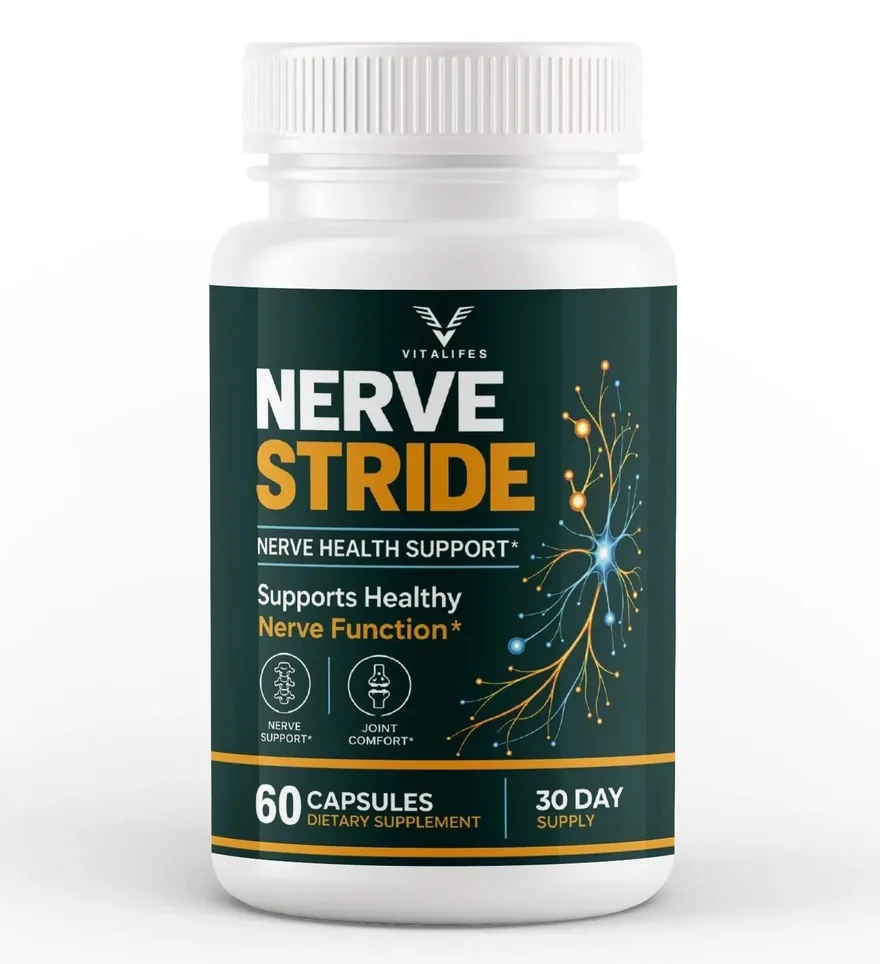
- 01How much vitamin B6 you are taking, in total
This bottle puts B6 inside a blend with no amount. Its position caps it at 100 mg a day, which is exactly the adult upper limit, and high-dose B6 is itself a cause of nerve damage. If you take anything else containing B6, add it up before you add this.
- 02That the blend on the bottle is called <q>Test Boost</q>
On a product sold for nerve support. Nothing supplied to this site explains it. You are entitled to ask the desk what it means before you pay.
- 03That two vitamins are inside the blend, where they should not be
FDA’s labelling guide says ingredients with Daily Values must be listed separately with their individual weights. B6 and B12 are not.
- 04Whether you take an anticoagulant
Ginkgo is seventh on this panel. NIH: it
may increase the risk of bleeding in people who are taking anticoagulant drugs, such as warfarin
.
Where to buy itWhat was not supplied
- Nine ingredients, one 600 mg blend, no amounts
- Two vitamins inside the blend, where the rules say they cannot be
- USA Authorized NerveStride Retailer
This site holds no stock and takes no payment. No price and no guarantee term were supplied to it, so it prints neither. Whatever the checkout shows when you are there governs.
What this page was checked against
Every figure on it is transcribed from the supplied Supplement Facts panel and checked-out pack, derived by arithmetic from those, or taken from a source on the references page.